
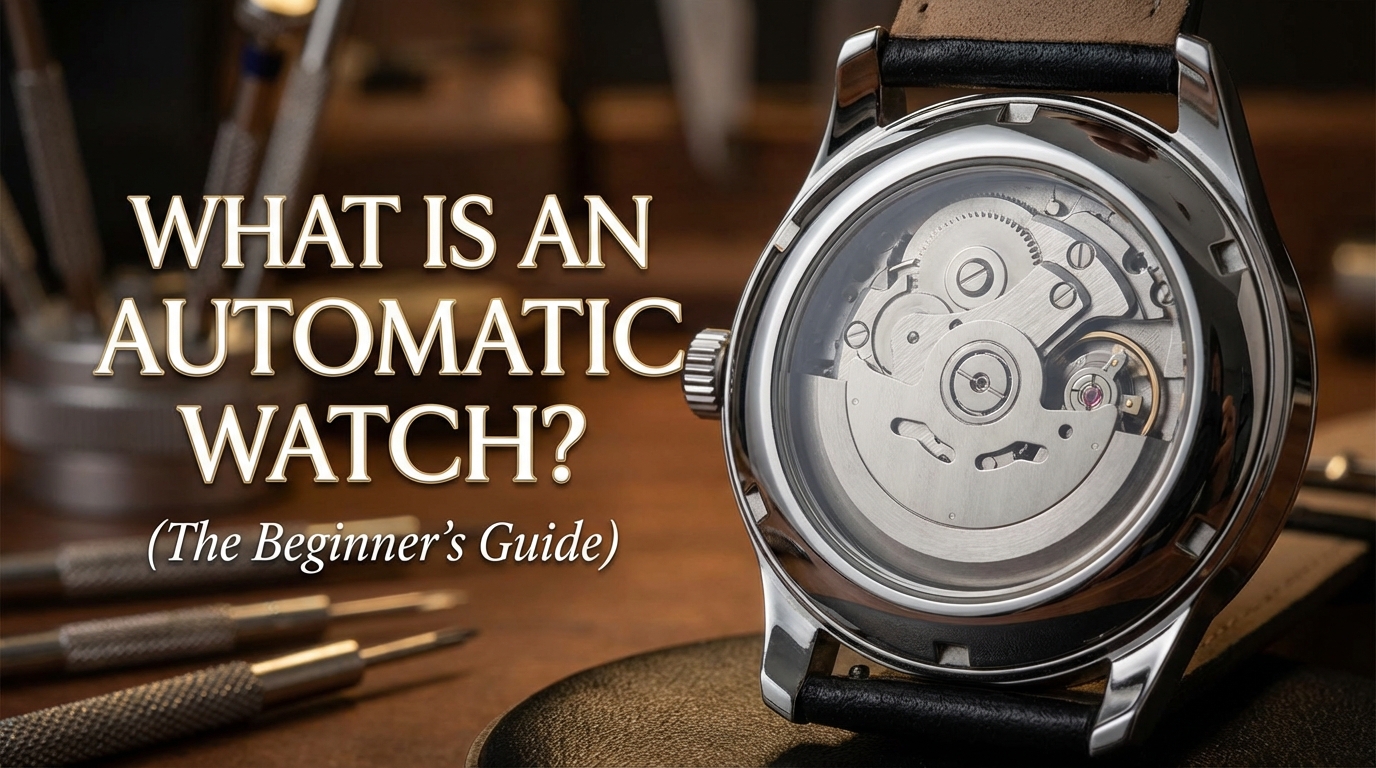

What Is an Automatic Watch?
Your Wrist Is Powering a Machine
An automatic watch has a heartbeat.
Not metaphorically. Literally. Inside the case, a balance wheel oscillates back and forth 21,600 or 28,800 times per hour. That oscillation is regulated by a hairspring—a coiled spring thinner than a human hair that expands and contracts with each beat. No battery. No circuit board. No quartz crystal. Just gears, springs, and physics.
This is a mechanical device that tells time using principles that haven't changed since the 1700s.
How It Actually Works: The Rotor and Mainspring
The term "automatic" refers to how the watch winds itself.
A weighted rotor sits on a pivot inside the case. When you move your wrist, the rotor spins. That spinning motion is transferred through a series of gears to wind the mainspring—a long, coiled spring that stores energy. As the mainspring slowly unwinds, it releases energy through the gear train, which powers the escapement (the mechanism that controls the balance wheel), which ultimately moves the hands.
The genius is that your natural wrist movement keeps the watch wound.
You don't need to remember to wind it manually (though most modern automatics allow hand-winding as a backup). Wear the watch daily, and it stays powered indefinitely. Take it off and set it down, and the mainspring keeps unwinding until the energy is depleted—usually 38 to 80 hours depending on the movement. When the mainspring runs out, the watch stops. (This is called the power reserve, and it's one of the key specs to look for.)
The Parts That Matter (And Why)
Understanding a few key components makes everything else make sense.
The Balance Wheel: The Heart
The balance wheel is the regulating organ of the watch. It oscillates back and forth, controlled by the hairspring. The number of oscillations per hour is called the beat rate, measured in bph (beats per hour) or Hz (hertz). Most affordable automatics run at 21,600 bph (3 Hz) or 28,800 bph (4 Hz).
Higher beat rates mean smoother seconds hand sweep. A 21,600 bph movement ticks 6 times per second. A 28,800 bph movement ticks 8 times per second. The difference is subtle but noticeable—the higher beat rate looks more fluid. (Luxury watches often run at 36,000 bph or higher, but the difference between 28,800 and 36,000 is barely perceptible.)
Beat rate also affects accuracy. Higher beat rates are generally more stable because each oscillation is shorter, which means environmental factors (temperature, position) have less time to affect each individual cycle. (This is why Swiss chronometers often use 28,800 bph movements—it's easier to regulate for accuracy.)
The Mainspring: The Battery
The mainspring is the energy storage. It's a long, flat spring coiled inside a barrel. When fully wound, it stores enough energy to run the watch for 38-80+ hours depending on the movement design. As it unwinds, the tension decreases, which is why some watches run faster when fully wound and slower as the power reserve depletes.
Power reserve is the specification that tells you how long the watch will run from a full wind. A 40-hour power reserve means you can wear the watch all day, take it off at night, and it'll still be running the next morning. An 80-hour power reserve means you can take the watch off Friday night and it'll still be running Monday morning. (If you rotate multiple watches, a longer power reserve is crucial—you won't have to reset the time and date constantly.)
The Escapement: The Gatekeeper
The escapement controls the release of energy from the mainspring to the balance wheel. It's the ticking mechanism—literally. The "tick-tick-tick" sound you hear is the escapement engaging and releasing the gear train. The escapement ensures that energy is released in controlled, consistent increments, which keeps the watch running at a steady rate.
The Swiss lever escapement is the standard design used in 95%+ of mechanical watches. It's been refined over 200+ years and is reliable, efficient, and well-understood. (Some high-end watches use co-axial or silicon escapements for improved efficiency, but at the sub-$500 level, you're getting a traditional lever escapement.)
What Makes It "Automatic" vs. Manual
The difference between automatic and manual-winding is simple: the rotor.
Manual-winding watches don't have a rotor. You wind them by turning the crown (the knob on the side of the case). Each turn of the crown winds the mainspring a little more until it's fully wound. Then you wear the watch, and the mainspring unwinds over the next 38-60 hours until it's depleted. Repeat.
Automatic watches have a rotor that winds the mainspring as you move. Most automatic movements also allow hand-winding (you can turn the crown to manually wind the mainspring), which is useful if the watch has stopped and you want to get it running immediately. (Some cheaper automatics don't allow hand-winding—the crown only sets the time, not winds the spring. This is cost-cutting and annoying.)
Hacking vs. non-hacking is another feature that separates budget from quality. Hacking means the seconds hand stops when you pull the crown out to set the time. This lets you synchronize the watch precisely with a reference time. Non-hacking movements keep the seconds hand running even when the crown is pulled, which makes precise time-setting impossible. (All modern automatics should hack. If they don't, it's a sign of corner-cutting.)
Why It Stops (And Why That's Normal)
Your automatic watch will stop if you don't wear it.
This is not a defect. The mainspring has a finite amount of stored energy. When that energy is depleted, the watch stops. If you wear the watch daily, the rotor keeps the mainspring wound and the watch runs indefinitely. If you take the watch off and leave it on a dresser for 2-3 days, it'll stop.
When it stops, you have two options:
- Hand-wind it (if the movement supports hand-winding). Turn the crown clockwise 20-30 times until you feel resistance. This winds the mainspring. Then set the time and go.
- Shake it to start the rotor. Hold the watch and shake your wrist back and forth 20-30 times. The rotor will spin and start winding the mainspring. Then set the time. (This is less precise than hand-winding, but it works if your movement doesn't support hand-winding.)
If you own multiple watches, invest in a watch winder. A watch winder is a motorized device that rotates your watch when you're not wearing it, keeping the rotor spinning and the watch wound. They cost $50-200 depending on quality. (Single-watch winders are cheap; multi-watch winders with programmable rotation settings are expensive but worth it if you rotate a collection.)
Accuracy: Why Your Watch Isn't Perfect (And Why That's the Point)
An automatic watch gains or loses 10-30 seconds per day.
This is normal. Mechanical watches are controlled by a balance wheel oscillating thousands of times per hour. That oscillation is affected by temperature (heat makes the hairspring expand, cold makes it contract), position (dial-up vs. crown-down affects the balance wheel differently), magnetism (magnetic fields distort the hairspring), and how fully wound the mainspring is.
Your phone tells the perfect time because it syncs with atomic clocks via the internet. Your quartz watch is accurate to +/- 15 seconds per month because the crystal oscillates at 32,768 Hz, which is far more stable than a mechanical balance wheel. Your automatic watch is accurate to +/- 10-30 seconds per day because it's a mechanical device operating in the real world.
If you want perfect accuracy, buy quartz. If you want to appreciate engineering, buy mechanical.
What's Acceptable Accuracy?
COSC chronometer standard: +/- 4 to +/- 6 seconds per day. This is the gold standard for Swiss chronometers. Only a small percentage of mechanical movements qualify. (If your watch is COSC-certified, it'll say so on the dial. If it doesn't say "Chronometer," it's not COSC-certified.)
Standard mechanical accuracy: +/- 10 to +/- 30 seconds per day. Most affordable automatics (Seiko 4R, Miyota 8200, ETA 2824) fall into this range. If your watch is running +/- 15 seconds per day, that's excellent for a non-chronometer movement.
Acceptable variance: +/- 30 seconds per day is the upper limit of acceptable. If your watch is running +/- 60+ seconds per day, something is wrong—it might be magnetized, damaged, or in need of regulation.
Regulation is the process of adjusting the balance wheel to improve accuracy. A watchmaker can regulate your watch for $50-100 by adjusting the length of the hairspring. This can bring a +/- 30 second/day watch down to +/- 10 seconds/day in most cases. (Regulation is a normal part of mechanical watch ownership—expect to have it done every 3-5 years.)
The Ritual: Why People Love Automatics
Wearing an automatic watch is different from wearing quartz or a smartwatch.
You notice it. The slight weight on your wrist. The smooth sweep of the seconds hand (not the tick-tick-tick of quartz). The ritual of winding it when it stops. The minor inconvenience of resetting the date if you didn't wear it for three days. These aren't bugs—they're features.
An automatic watch requires attention. It's not set-and-forget like an Apple Watch. You have to interact with it. Wind it. Set it. Monitor its accuracy. Appreciate the engineering. (This is why watch enthusiasts love automatics—they're engaging in a way that quartz and smartwatches aren't.)
There's also the lifespan argument. A quality automatic watch, properly maintained, will outlive you. Service it every 5-7 years (full movement cleaning, lubrication, new gaskets) and it'll run for 50+ years. A smartwatch is obsolete in 3-5 years when the software stops updating or the battery degrades. A quartz watch lasts 10-20 years before the movement fails and replacement costs more than buying new.
An automatic watch is generational. You can pass it to your kids. They can pass it to theirs. (A $400 Seiko serviced regularly will outlast a $500 Apple Watch by decades. The Seiko becomes an heirloom. The Apple Watch becomes e-waste.)
The Maintenance Reality: What It Actually Costs
Automatic watches need service.
Every 5-7 years, you should have the movement cleaned, lubricated, and inspected. This is called a full service. A watchmaker disassembles the movement, cleans every part in an ultrasonic cleaner, replaces worn components (usually just gaskets and seals), re-lubricates the gear train, reassembles everything, and pressure-tests the case for water resistance.
Cost for a full service:
- Seiko/Miyota/Orient movements: $100-200 at an independent watchmaker
- Swiss ETA/Sellita movements: $150-250 at an independent watchmaker
- Luxury in-house movements: $500-1,000+ (must go to brand-authorized service centers)
If you skip service, the watch will keep running—for a while. Lubrication dries out over 5-10 years, which increases friction, which increases wear on pivots and jewels. Eventually, pivots wear down, the movement loses accuracy, and repair costs skyrocket. (A $150 service every 7 years prevents a $500 repair down the line. It's insurance.)
Water resistance degrades over time as gaskets dry out. If you swim with your watch, have it pressure-tested every 3-5 years ($20-50 service). If the gaskets fail, water gets inside, the movement rusts, and the watch is toast. (Water damage is the #1 killer of automatic watches. Prevention is cheap; repair is expensive or impossible.)
The Investment Perspective: Why $400 Automatics Make Financial Sense
A $400 automatic watch is a better long-term investment than a $400 smartwatch.
The math:
- Automatic watch: $400 purchase + $150 service every 7 years = $21/year over 50 years
- Apple Watch: $400 purchase + replacement every 4 years = $100/year over 20 years (then it's obsolete)
The automatic watch costs less per year and lasts longer. It also has resale value—Seiko, Orient, and Citizen watches hold 40-60% of original value on the used market. Smartwatches are worth $50-100 after 2-3 years because the software is outdated.
There's also the intangible value. An automatic watch doesn't track your steps, read your texts, or need charging. It's not obsolete when iOS 25 drops support for your model. It's a single-purpose tool that does one thing well: tells time. (In a world where everything is connected, disposable, and algorithmically optimized, there's value in owning something simple and permanent.)
Ready to Make Your First Move?
You understand the basics now. You know how an automatic watch works, why it's not as accurate as quartz, and why people choose mechanical over digital despite the inconvenience.
The next step is choosing the right watch. Start with our curated list of the best automatic watches under $500. We've tested movements, evaluated finishing, and ranked watches based on real-world performance—not marketing claims or affiliate kickbacks.
(Spoiler: The best first automatic isn't always the most expensive. It's the one that fits your wrist, matches your lifestyle, and makes you excited to check the time.)


Disclaimer:
We promote and review products available on the AliExpress marketplace. Some of the links we share may be affiliate links, which means we may earn a commission if you make a purchase through them—at no additional cost to you. Our reviews and recommendations are based on our own opinions and are intended to help you make informed purchasing decisions. We are not directly affiliated with or responsible for the products, sellers, or services on AliExpress. Please review product details and seller information carefully before making any purchase.