
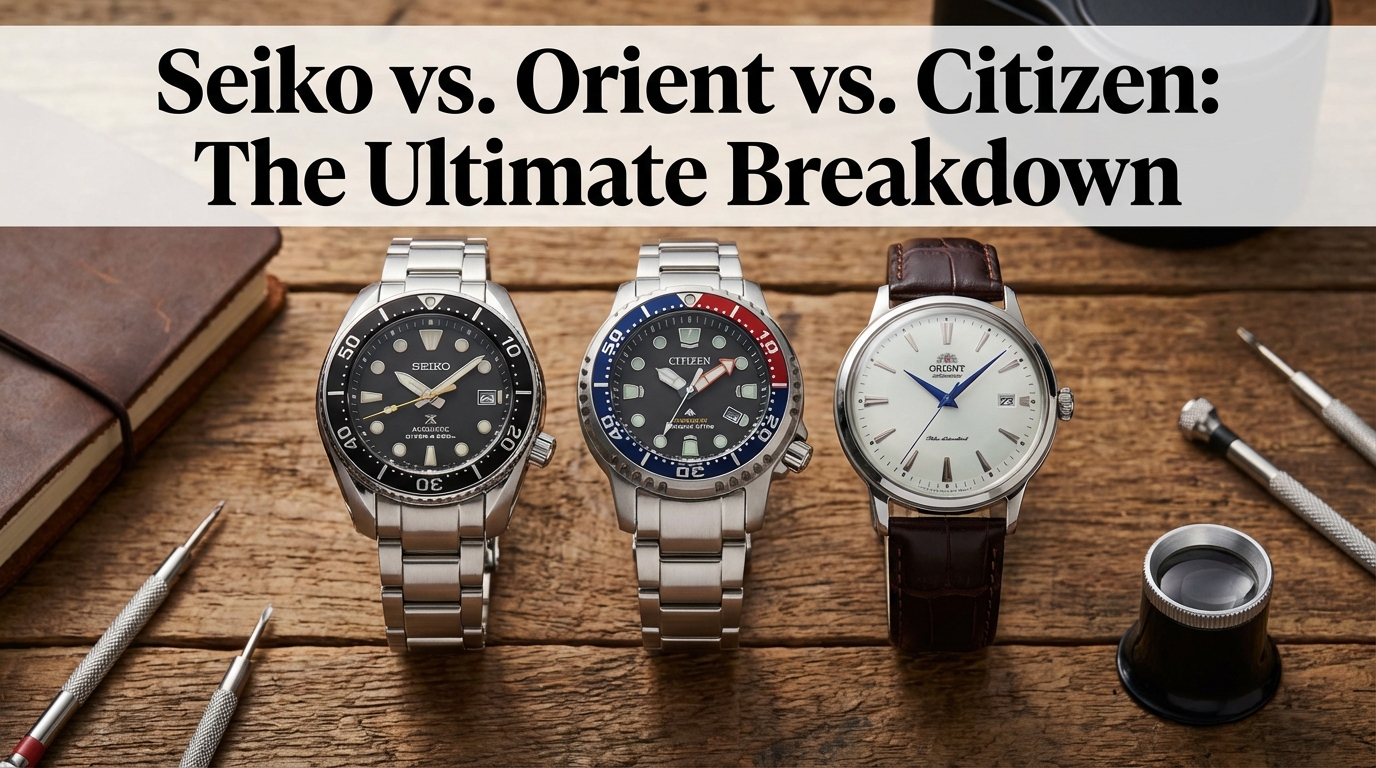

Seiko vs. Orient vs. Citizen: The Ultimate Breakdown
The Big Three: Japan's Horological Cold War
Seiko, Orient, and Citizen have been fighting for market dominance since the 1950s.
This isn't a friendly competition. These brands compete on every level—entry-level automatics, mid-range complications, high-end finishing. For anyone shopping under $500, this rivalry works in your favor: each brand is forced to deliver more value just to stay competitive. The Ford vs. Chevy analogy is perfect—die-hard partisans exist for each brand, and they'll defend their choice with religious fervor on forums like WatchUSeek.
But which one actually deserves your money?
Movement Architecture: Where the Real Differences Live
The movement is the heart of any automatic watch. Everything else—case finishing, dial design, bracelet quality—is secondary to the reliability and performance of what's ticking inside.
Seiko uses in-house movements exclusively. The 4R35, 4R36, 6R15, and NH35 family all come from Seiko's own factories. Orient does the same—their F6 and F7 series are proprietary designs. Citizen is the outlier: they use Miyota movements (which Citizen owns, but Miyota also supplies competitors).
This matters because in-house movements give brands complete control over quality, parts availability, and service networks.
Seiko 4R35/4R36: The Industry Standard
Beat rate: 21,600 bph (6 beats per second)
Jewels: 23 or 24 depending on variant
Power reserve: 41 hours
Hacking: Yes
Hand-winding: Yes
Typical accuracy: +/- 15 to +/- 25 seconds per day
The 4R36 is the workhorse that powers everything from $200 Seiko 5s to $600 Presage models. It's a modernized version of the 7S26 (which ran for decades without hacking or hand-winding capability). The 4R series added both features in 2006, and it's been the backbone of Seiko's affordable lineup ever since.
What it feels like to wind: Smooth but not luxurious. There's slight resistance as you turn the crown, and you can feel the mainspring engaging. It's mechanical without being overly refined. (Think Honda Civic engine—reliable, functional, no-nonsense.)
Accuracy in the real world: Expect +15 to +20 seconds per day out of the box. Some people get lucky and land in the +5 to +10 range, but that's not guaranteed. The movement can be regulated by a watchmaker for $50-100 if it's running outside acceptable limits. Position affects accuracy—dial-up tends to run slower, crown-down tends to run faster.
Reliability: Bulletproof. The 4R series has been in production for nearly two decades with minimal issues. Parts are cheap, any watchmaker can service it, and it's known for running reliably even when neglected. (I've seen 4R movements keep running after years without service—not recommended, but testament to the design.)
The one weakness: Rotor noise. The ball-bearing rotor system in the 4R family is louder than Miyota or ETA equivalents. You'll hear it if you shake your wrist in a quiet room. Some people find this charming (mechanical feedback), others find it annoying.
Orient F6722/F6724: The Finishing Champion
Beat rate: 21,600 bph (6 beats per second)
Jewels: 22
Power reserve: 40 hours
Hacking: Yes (on F6924 only; F6722/F6724 do NOT hack)
Hand-winding: Yes
Typical accuracy: +/- 15 to +/- 25 seconds per day
Orient's F6 and F7 series movements are less common than Seiko's, but they're just as reliable. The F6722 powers the Bambino line, while the F6924 (hacking version) appears in higher-end Orient models. These movements are designed with finishing in mind—even entry-level Orients have decorated rotors and perlage on the bridges.
What it feels like to wind: Noticeably smoother than the 4R36. The crown action is refined, and there's less resistance when hand-winding. It feels more expensive than it is. (This is where Orient wins on tactile experience—the movement "feels" premium even in a $150 watch.)
Accuracy in the real world: Similar to Seiko—expect +/- 15 to +/- 20 seconds per day. Orient movements tend to settle into consistent patterns after a few weeks of wear. The lack of hacking on most F6 movements is the major drawback; when you pull the crown to set the time, the seconds hand keeps moving. (You have to time your adjustments, which is annoying if you care about precision.)
Reliability: Excellent. Orient movements are less common in the wild than Seiko's, but watchmakers familiar with them report similar longevity. The caveat: parts availability is lower than Seiko. If something breaks, you might wait weeks for an Orient-specific component. (Most watchmakers stock Seiko parts; fewer stock Orient.)
The one weakness: No hacking on the F6722/F6724. This is inexcusable in 2026 when even $100 watches hack. The F6924 fixes this, but it's only found in higher-priced Orient models. If you need to set your watch precisely (for work, travel, etc.), the lack of hacking is frustrating.
Miyota 8200/9015: The Smooth Operator
Beat rate (8200): 21,600 bph
Beat rate (9015): 28,800 bph (8 beats per second)
Jewels: 21 (8200) or 24 (9015)
Power reserve: 40-42 hours
Hacking: Yes
Hand-winding: Yes (9015 only on some variants)
Typical accuracy: +/- 20 to +/- 30 seconds per day (8200), +/- 10 to +/- 20 (9015)
Citizen owns Miyota, but Miyota operates semi-independently and sells movements to third parties (microbrands, fashion watches, etc.). The 8200 is the budget workhorse, found in sub-$300 automatics. The 9015 is the premium option, with a higher beat rate and better finishing.
What it feels like to wind: The 8200 has minimal resistance—almost too easy. It feels less substantial than the Seiko or Orient equivalents. The 9015 is smoother and more refined, with noticeable improvement in crown action and rotor smoothness. (The 9015 is the movement you want if you're buying a Citizen—the 8200 feels cheap in comparison.)
Accuracy in the real world: The 8200 is loose—expect +/- 20 to +/- 30 seconds per day, sometimes worse. The 9015 is much tighter at +/- 10 to +/- 20 seconds per day, closer to Swiss ETA 2824 territory. If accuracy matters, avoid the 8200.
Reliability: Both movements are reliable, but the 8200 rotor is notoriously loud. It sounds like a marble rolling around inside the case. This is normal (the bearing system is simpler to keep costs down), but it's jarring if you're used to quieter movements. The 9015 is much quieter and feels like a different class of movement entirely.
The one weakness (8200): Loud rotor and loose accuracy tolerances. The 9015 is excellent, but it's rare in sub-$500 watches. Most Citizen automatics at this price use the 8200, which is the weakest link in the Big Three comparison.
Head-to-Head: The Technical Shootout
Let's stop being diplomatic and rank these movements by actual performance.
Best Overall Movement: Seiko 4R36
Why it wins: Ubiquity, parts availability, proven reliability. The 4R36 is the safe choice—any watchmaker can service it, parts are cheap, and it's been refined over 15+ years. It's not the smoothest or the prettiest, but it's the most practical.
Runner-up: Miyota 9015 (if you can find it in your budget). Higher beat rate, smoother operation, better accuracy. The problem is availability—most sub-$500 Citizen watches use the 8200, not the 9015.
Best Finishing: Orient F6722/F6724
Why it wins: Decorated rotors, perlage on bridges, superior hand-winding feel. Orient prioritizes aesthetics and tactile experience. Even budget Orient movements look better through a caseback than budget Seiko movements. (If you care about what the movement looks like, Orient wins decisively.)
Caveat: The lack of hacking on most F6 movements is a major drawback. If Orient added hacking to the F6722, this would be the undisputed champion.
Best Accuracy: Miyota 9015
Why it wins: 28,800 bph beat rate and tighter tolerances. The 9015 consistently delivers +/- 10 to +/- 15 seconds per day, which is exceptional for a non-chronometer movement. (This is COSC-adjacent performance at a fraction of the cost.)
Caveat: Rare in sub-$500 watches. You'll find it in higher-end Citizen models or microbrands, but not in the typical $300 Citizen Promaster.
Worst Choice: Miyota 8200
Why it loses: Loud rotor, loose accuracy, cheap feel. The 8200 is functional, but it's the weakest of the Big Three movements. If you're buying a Citizen, make sure it has the 9015 or skip it.
Brand Philosophy: What You're Really Buying
Movements are just part of the equation. Each brand has a distinct design philosophy and target customer.
Seiko: Heritage and Innovation
Seiko's strength is breadth. They make everything from $100 quartz watches to $10,000 Grand Seikos. Their sub-$500 lineup includes dress watches (Presage), dive watches (5 Sports, Prospex), field watches, and GMTs. You're buying into a brand with 140+ years of history, legitimate innovations (quartz crisis, Spring Drive, kinetic movements), and global recognition.
The downside: Seiko knows their brand power and prices accordingly. A Seiko with a 4R36 movement and Hardlex crystal costs $400. A microbrand with the same movement and sapphire crystal costs $250. You're paying for the Seiko name.
Best for: People who want brand heritage, resale value, and a watch that normies recognize. (Your coworkers know Seiko. They don't know the Orient.)
Orient: The Value King
Orient's entire philosophy is "deliver more watches for less money." They're owned by Seiko but operate independently, and their pricing undercuts Seiko by 30-40%. A $200 Orient Bambino has better finishing than a $400 Seiko 5. Orient prioritizes aesthetics—dial finishing, case proportions, hand design—over brand marketing.
The downside: Lower brand recognition means worse resale value. Orient watches are harder to sell because fewer people know the brand. Also, service networks are smaller—if you need warranty work, you're shipping the watch, not walking into a local AD.
Best for: Value-focused buyers who care about finishing and don't need brand prestige. (Watch enthusiasts love Orient. Normies have never heard of it.)
Citizen: The Tool Watch Specialist
Citizens focus on function over form. Their Eco-Drive quartz technology dominates their lineup, but their mechanical watches (Promaster line) are serious tool watches. ISO-certified dive watches under $300. Robust cases, reliable movements, practical designs. You're buying a tool, not jewelry.
The downside: Aesthetics are utilitarian at best, ugly at worst. Citizen watches are chunky, dated-looking, and often have awkward case proportions. They're built to survive, not to impress. (A Citizen Promaster is the Timex Ironman of automatics—it works great, but nobody's complimenting it at dinner.)
Best for: People who need a watch that takes abuse. Hikers, divers, travelers, military. (If you're worried about scratching your watch, don't buy Citizen. If you want a watch that survives a deployment, buy Citizen.)
Case Finishing and Build Quality: Where the Money Shows
Movements are internal—most people never see them. Case finishing, bracelet quality, and dial work are what you experience daily.
Seiko: Inconsistent Quality Control
Seiko's finishing varies wildly depending on price. A $150 Seiko 5 has rough case edges, misaligned chapter rings, and hollow-link bracelets. A $500 Seiko Presage has polished bevels, applied indices, and solid end links. The problem is that Seiko's QC is hit-or-miss even within the same model—one watch will be perfect, the next will have a misaligned bezel.
The bracelet situation is particularly bad. Sub-$300 Seikos come with hollow-link bracelets that rattle and feel cheap. Upgrade to a Strapcode or Uncle Seiko bracelet ($60-100) and the watch feels twice as expensive.
Dial finishing: Seiko's strength. Presage models have guilloche, sunburst, enamel, and lacquer dials that rival Swiss watches at 3x the price. Even budget Seiko 5s have clean printing and good lume.
Orient: Best Finishing at This Price
Orient punches above its weight on finishing. A $200 Orient Bambino has polished bevels, applied indices, domed crystals, and dial work that competes with $800+ Swiss watches. The hands are properly shaped and finished, the printing is crisp, the case edges are smooth.
The bracelet quality is better than Seiko's at the same price point. Solid end links, decent clasp action, minimal rattle. (Still not amazing—you'll want to upgrade eventually—but better than Seiko's hollow-link disasters.)
The weakness: Mineral crystal on most models. Orient uses sapphire on higher-end pieces, but the Bambino, Ray, and Kamasu lines still use minerals. This is cost-cutting, and it's frustrating when $250 microbrands include sapphire.
Citizen: Function Over Form
Citizen's case finishing is utilitarian. Brushed cases, basic polishing, chunky proportions. The goal is durability, not elegance. (A Citizen Promaster looks like it was designed by an engineer, not a designer. That's a feature, not a bug, depending on your priorities.)
Bracelet quality on Citizen dive watches is surprisingly good. Solid construction, push-button clasps, minimal flex. They feel tool-grade, which matches the watch's purpose.
Dial finishing is where Citizen falls behind. Basic printing, simple indices, functional lume. No guilloche, no sunburst, no flair. (If you care about dial aesthetics, buy Orient or Seiko. If you care about legibility in low light, Citizen's lume is excellent.)
The Verdict: Who Wins?
There's no universal winner—each brand excels in different areas.
Best Heritage: Seiko
Seiko has 140+ years of history, legitimate innovations, and global brand recognition. If you want a watch that people respect, that holds resale value, and that comes from a brand with serious horological credentials, buy Seiko. The 4R36 movement is the industry standard for a reason.
Recommended: Seiko 5 Sports SRPD or Seiko Presage Cocktail Time
Best Finishing: Orient
Orient delivers $800 Swiss finishes at $200 Japanese prices. If you care about dial work, case proportions, and tactile quality, Orient is unbeatable in this price range. The lack of sapphire crystal is frustrating, but the overall package is exceptional.
Recommended: Orient Bambino V7 or Orient Kamasu
Best Tool Watch: Citizen
Citizen's Promaster line delivers ISO-certified dive watches with proven reliability. If you need a watch that works—not a watch that impresses—Citizen is the practical choice. The Miyota 8200 is loud and loose, but it's reliable and cheap to service.
Recommended: Citizen Promaster Mechanical Diver
Best Value (Hybrid Pick): Orient with a Seiko Movement
Here's the secret: Some microbrands use Seiko NH35 movements in Orient-style cases. You get Seiko's ubiquitous movement with Orient-level finishing. Brands like Islander, Homebrew, and Axios do this well. (You lose brand heritage, but you gain specs and finishing.)
Recommended: Islander Automatic Dive Watch
The Semantic Ecosystem: What to Read Next
Each of these brands has strengths, but choosing the right watch depends on how you'll use it. If you want to see how these brands rank against each other in the real world, check out our guide on the best automatic watches under $500. We've tested and ranked specific models across all three brands based on movement performance, finishing quality, and real-world durability—not marketing hype.
(Spoiler: The winner might surprise you. It's not always the most expensive option.)


Disclaimer:
We promote and review products available on the AliExpress marketplace. Some of the links we share may be affiliate links, which means we may earn a commission if you make a purchase through them—at no additional cost to you. Our reviews and recommendations are based on our own opinions and are intended to help you make informed purchasing decisions. We are not directly affiliated with or responsible for the products, sellers, or services on AliExpress. Please review product details and seller information carefully before making any purchase.