
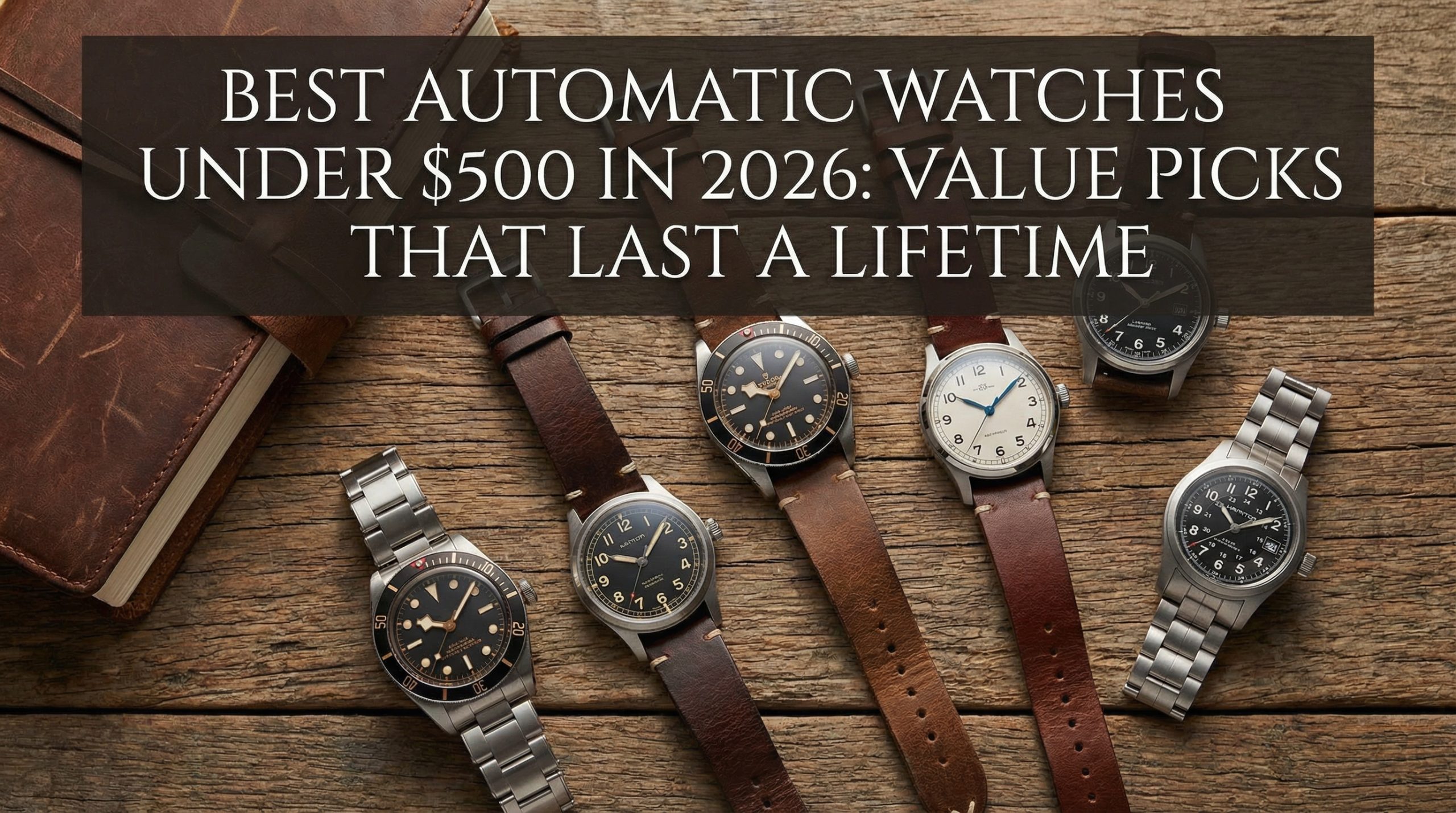

Best Automatic Watches Under $500 in 2026: Value Picks That Last a Lifetime
Best Automatic Watches Under $500 in 2026: Value Picks That Last a Lifetime
The Luxury Lie They Keep Selling You
The watch industry wants you to believe that real horology starts at $5,000.
That’s complete nonsense. In 2026, the gap between a well-chosen $500 automatic and an entry-level “luxury” piece has shrunk to nearly nothing in terms of build quality, movement reliability, and actual timekeeping performance. The main difference? Marketing budgets and boutique rent. You’re not getting a watch that’s 10 times better—you’re paying for a logo and the privilege of walking into a store with champagne on tap.
The truth is this: you can get legitimate mechanical watchmaking for under $500, and it’ll outlast your car.
Why 2026 is the Golden Age of Affordable Automatics
Something shifted in the last few years, and it’s working in your favor.
The microbrand revolution has forced legacy brands to compete on value. Companies like Seiko, Tissot, and Citizen can’t coast on reputation anymore when a $300 microbrand delivers sapphire crystal, ceramic bezels, and the same Miyota or NH35 movements. The big names responded by actually improving their sub-$500 offerings instead of just slapping new colors on 30-year-old designs. (Looking at you, Seiko—though you’re still guilty of Hardlex at $400, which is unforgivable.)
Meanwhile, case sizes are finally getting sane again.
The 42-44mm monstrosity trend is dead. 38-40mm is back as the sweet spot, which means these watches actually fit human wrists instead of looking like wall clocks strapped to your arm. If you’ve got a 6.5-7 inch wrist, you’re no longer forced to choose between a dinner plate or a vintage piece that costs three months’ rent.

What You’re Actually Getting for $500 (And What You’re Not)
Let’s set realistic expectations before we dive into specific watches.
What $500 buys you in 2026:
- Reliable automatic movements (Seiko NH35, Miyota 9015, ETA 2824 clones, or Swiss Sellita derivatives)
- Sapphire crystal (on most—but watch out for brands still using mineral crystal or “Hardlex”)
- Solid construction (316L stainless steel cases, proper finishing)
- 100-200m water resistance (daily wear proof, some actual dive capability)
- Accuracy of +/- 15 to +/- 25 seconds per day (which is perfectly fine for mechanical)
What you’re NOT getting:
- In-house movements (you’re getting reliable workhorses, not proprietary engineering)
- Perfect finishing (expect minor machining marks if you look close with a loupe)
- Prestige (nobody’s impressed by Seiko at a business dinner, and that’s okay)
- Quartz accuracy (mechanical watches gain/lose time—that’s the point)
The question isn’t “Is this as good as a Rolex?” The question is “Does this deliver legitimate watchmaking at a price that doesn’t require a loan?”
The answer is yes.
The Technical Specs That Actually Matter
Stop obsessing over rotor design and date window fonts. Here’s what you should actually care about:
Movement
The NH35/NH36 is the unkillable workhorse of the watch world. Seiko’s movement powers half the automatics under $1,000, including microbrands that charge twice what Seiko does. It’s reliable, serviceable anywhere, and parts are cheap. Accuracy is typically +/- 20 seconds per day, which sounds terrible if you’re used to quartz, but it’s standard for entry-level mechanical.
Miyota 9015 is smoother (higher beat rate at 28,800 bph) and slightly more accurate, but also more expensive to service. Sellita SW200 is the Swiss equivalent—basically an ETA 2824 clone that’s just as reliable but costs more because “Swiss Made” gets stamped on the dial.
(If someone tells you that you need an in-house movement to have a “real” watch, they’re either selling you something or they’ve inhaled too much watch forum kool-aid.)
Crystal
I don’t care what the marketing says—Hardlex is not Sapphire. If you’re spending $400+, demand sapphire crystal. It’s scratch-resistant (not scratch-proof, but close), and it’s the difference between a watch that looks new after five years versus one that looks like it survived a sandstorm.
Mineral crystal scratches if you look at it wrong. Hardlex is Seiko’s proprietary mineral crystal that’s “harder than standard mineral” but still scratches easier than sapphire. At this price point, there’s no excuse for anything less than sapphire.
Water Resistance
100m/10 ATM is the minimum for daily wear. This doesn’t mean you can dive 100 meters—it means the watch can handle rain, hand washing, and accidental splashes. 200m/20 ATM is true dive-watch territory and gives you a safety margin for swimming and snorkeling.
(Water resistance degrades over time as gaskets age. Get it pressure-tested every 3-5 years if you actually plan to swim with it.)
Power Reserve
40+ hours is the standard, which means you can take the watch off Friday night and it’ll still be running Monday morning. Some movements push 70-80 hours, which is nice if you rotate watches, but not essential. Anything under 38 hours is annoying—you’re winding it every other day.
Disclaimer:
We promote and review products available on the AliExpress marketplace. Some of the links we share may be affiliate links, which means we may earn a commission if you make a purchase through them—at no additional cost to you. Our reviews and recommendations are based on our own opinions and are intended to help you make informed purchasing decisions. We are not directly affiliated with or responsible for the products, sellers, or services on AliExpress. Please review product details and seller information carefully before making any purchase.